

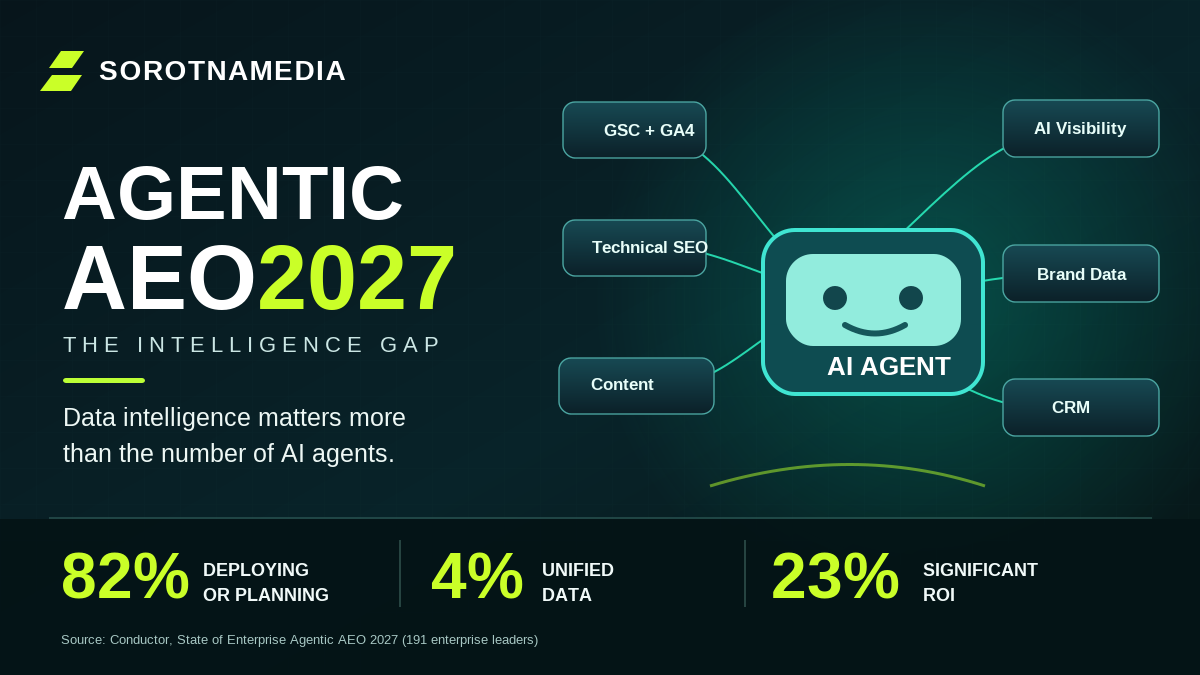
The short answer: AI agents are becoming part of enterprise Answer Engine Optimization (AEO), but deploying agents is not the same as building an effective AI Search strategy. Conductor’s The Intelligence Gap: State of Enterprise Agentic AEO 2027 reports that 82% of surveyed enterprises are deploying or planning AEO agents, while just 4% have fully unified AEO data or an intelligence layer feeding their systems.
It is easy to see the appeal. Agents can accelerate content research, monitor visibility, identify gaps, and generate recommendations. Yet a faster workflow does not automatically lead to more qualified leads or revenue. The important question is whether an agent understands the business, the market, and the evidence behind its recommendations.
Conductor’s findings are based on a survey of 191 marketing and technology leaders at organizations with at least 500 employees. They provide a useful enterprise benchmark as businesses plan their AI Search investments heading into 2027.
What Is Agentic AEO?
Agentic AEO uses AI agents to support or automate workflows intended to improve how a brand is found, cited, and recommended in AI-generated answers. Those workflows may include research, content analysis, AI citation monitoring, reporting, and prioritized optimization recommendations.
Traditional SEO still matters. Technical accessibility, helpful content, consistent entity information, and credible evidence all contribute to a stronger information foundation. Agentic AEO adds a system that can repeatedly observe signals, surface opportunities, and assist with execution.
It should not be confused with publishing AI-generated articles at scale. Agents need reliable inputs, clear objectives, documented permissions, and human oversight. No workflow can guarantee placement or recommendation in a particular AI answer.
Adoption Is Accelerating: 82% Are Deploying or Planning
Among the surveyed enterprises, 38% are already deploying AEO agents and another 44% intend to do so. Of those pursuing agentic AEO, 99% expect to increase investment over the following 12 months. These are reported plans, not verified future spending.
Content remains the leading application: 86% use agents in at least one content workflow. That compares with 62% for AI visibility and intelligence, 54% for reporting, and 36% for technical workflows. The imbalance matters because agents creating content may lack the signals needed to evaluate whether that content contributes to AI recommendations.
The Intelligence Gap: The Data Behind the Agent Is Fragmented
The report identifies fragmented data as the single biggest obstacle to agentic AEO progress, selected by 30% of respondents. A third (33%) still manage AEO data in silos, while another 22% have only partially connected data. Just 4% report full unification.
Consider an enterprise where SEO performance sits in Google Search Console, user behavior in GA4, sales outcomes in a CRM, and AI citations in a separate visibility tool. An agent receiving only keyword data cannot reliably infer whether a brand’s AI mentions led to commercial outcomes.
The opportunity is therefore not simply to buy more agents. 37% of respondents selected a unified platform connecting visibility, analytics, and technical data as the biggest accelerator for progress.
Measure AI Recommendations, Not Just Rankings or Mentions
Conductor found that 69% of respondents supply keyword and intent data to agents, but only 43% feed them AI citation and brand visibility data. That means many AI Search optimization workflows still lack direct evidence about AI Search performance.
A ranking report does not reveal whether an AI engine references a brand in a buying recommendation. A mention count also lacks context: a brand may be presented as a preferred solution, a neutral alternative, or an option with important caveats.
Useful AEO measurement should consider the prompt set, cited sources, recommendation context, competitor comparisons, and changes over time. Because AI responses vary by model, prompt, location, and timing, teams should use repeated tests rather than treating one generated answer as a definitive market signal.
Productivity and Visibility Are Improving. Significant ROI Is Harder to Prove.
Among organizations deploying AEO agents, 95% report a moderate or significant positive impact on productivity and 89% report the same for visibility in AI-generated answers. Yet only 23% report significant measurable ROI; another 23% report no ROI impact.
The survey also finds an association between data integration and ROI: 67% of the significant-ROI group have integrated or fully unified AEO data, compared with 26% of the no-ROI group. This is survey correlation, not evidence that data integration alone causes higher returns.
For leadership teams, content output and hours saved are operational indicators. Business outcomes should also include qualified leads, demo requests, sales opportunities, conversions, and revenue wherever measurement permits.
A Practical Agentic AEO Framework for Businesses
1. Establish a trusted data foundation
Audit the accuracy and ownership of Google Search Console, GA4, technical crawl data, CRM records, content inventories, and brand information. Define common KPIs and update schedules before automating decisions.
2. Build an AI visibility baseline
Develop a representative set of discovery, comparison, and purchase-intent questions. Track mentions, citations, recommendations, and competitive context over repeated runs.
3. Start with lower-risk agent workflows
Automate research, briefing, monitoring, and opportunity detection first. Keep technical changes, mass updates, and content publication subject to review and approval.
4. Strengthen evidence and entity clarity
Improve service and product pages with precise descriptions, relevant proof points, transparent business information, useful FAQs, and coherent internal linking. Prefer helpful, verifiable information over volume for its own sake.
5. Tie optimization back to business metrics
Combine AI visibility trends with CRM, forms, lead quality, and conversion data. Document attribution limitations rather than labeling all unexplained leads as AI Search conversions.
What Does This Mean for SEO and GEO Agencies?
According to Conductor, 51% of enterprises use a hybrid build-and-buy strategy for AEO agents. When choosing an external development partner, 47% prefer MarTech vendors and 18% prefer agencies.
That is a signal for agencies to differentiate through data interpretation, technical implementation, measurement, and strategic judgment—not only faster content generation. At Sorotnamedia, we view automation as a way to extend specialist capability while keeping the business objective and evidence at the center.
Conclusion: Intelligence Is the Advantage
The 2027 Agentic AEO report tells a two-part story: enterprise interest and investment are strong, but data readiness and ROI measurement have not caught up. More agents alone will not resolve that gap.
The teams best positioned to benefit are those connecting AI visibility, technical SEO, analytics, and customer outcomes into a trustworthy learning loop.
Explore Sorotnamedia’s GEO & AEO services to assess your AI Search visibility and build an evidence-led optimization plan.
Source and Methodology
Conductor, The Intelligence Gap: State of Enterprise Agentic AEO 2027. Survey of 191 manager-level and above marketing/technology leaders at organizations with 500+ employees. Findings reflect respondents’ reports; they do not establish causation or represent every business. Implementation recommendations are Sorotnamedia’s editorial analysis.